The room where every
surgery begins, automated
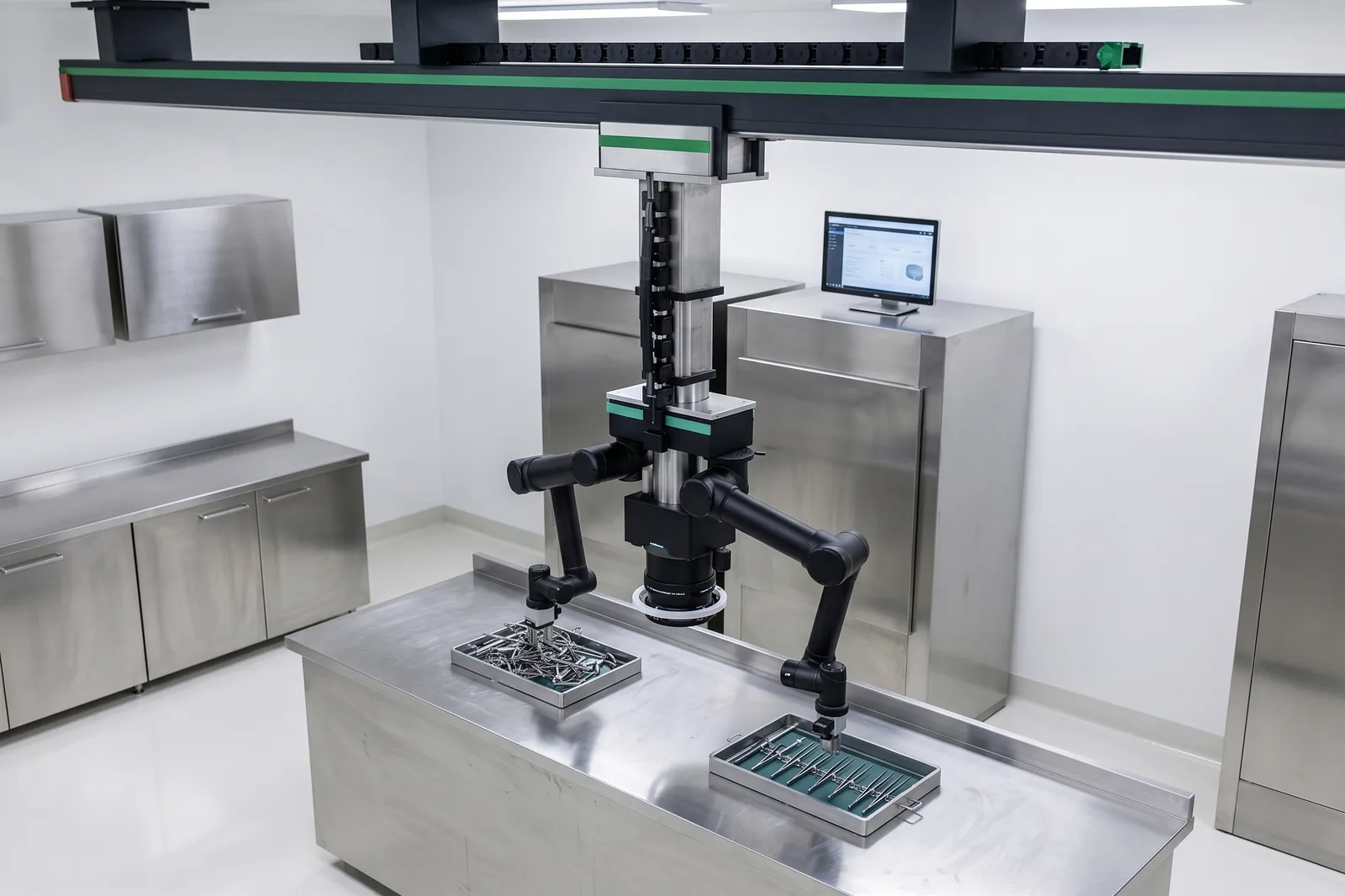
Hospitals reprocess millions of surgical instruments by hand, under a labor shortage that never lets up. Sterilux, Octavian's line of sterile-processing robots, starts with the entire post-wash bench: one station unloads the tray, inspects every instrument, reassembles it, and documents the result, guided by a Vision-Language-Action model that reasons about what clean really means.
The most critical room in the hospital still runs on hands
Sterile processing, the SPD, is where every used surgical instrument is cleaned, inspected, reassembled into trays, and sterilized before it can touch another patient. It is relentless, skilled, and almost entirely manual, and it is running short of the people to do it.
A workforce that can't keep up
SPDs face chronic understaffing and high turnover in a demanding, physically punishing role. Techs are asked to move faster on the exact task where a mistake reaches a patient.
Clean cannot be verified by eye
Residual blood and tissue hide in hinges, lumens, and box locks, invisible to a tired technician. When an instrument that looks clean still carries bioburden, it goes on to sterilization and into the next surgery. In this room, clean can be a matter of life or death.
The OR waits on the tray
Missing or incorrectly assembled trays delay cases, force immediate-use sterilization, and ripple straight into OR schedules. The whole surgical operation is gated by this one room.
One department, automated in the order that matters
We start with the busiest, highest-judgment bench in the room, the post-wash station, then extend the same platform upstream to decontamination and downstream toward the operating room. Each Sterilux station shares one platform, so every deployment makes the next one faster.
The post-wash station
After decontamination, one station takes the entire tray-processing job: it removes instruments from the tray, disassembles what needs it, inspects each one for residual soil, reassembles the tray, and logs an audit-grade record.
- Catches contamination the human eye misses at hinges and lumens
- Rebuilds the tray against the count sheet, with a per-instrument record
- Designed so one technician can oversee a bank of stations, stepping in for the judgment calls
Decontamination
The robot that does the cleaning itself, delivering consistent, validated decontamination of complex instrument geometries without relying on manual scrubbing under time pressure.
- Repeatable cleaning of hinges, lumens, and box locks
- Feeds inspection with a higher, steadier first-pass rate
- Removes the most physically punishing manual step
Storage and the OR
Extending the same platform downstream, into sterile storage and the case-cart steps that stage instruments back toward the operating room, closing the loop from wash to surgery.
- Keeps trays tracked and correct through sterile storage
- Stages case carts back toward the OR, on time
- Closes the loop: clean, checked, assembled, and delivered
The physical AI backbone for hospitals
Sterilux is built on a robotics foundation already proven across 120+ regulated facilities, and on years already spent developing a Vision-Language-Action model for unstructured assembly. The same core redeploys from the post-wash bench to decontamination and beyond, so each station ships faster than starting from scratch.
- 01
Vision-Language-Action model
A generalist model that reasons about what clean means and generalizes across thousands of instrument types, with no per-part programming. It is the capability the rest of the field does not have.
- 02
Unstructured assembly
Disassembles and reassembles varied, unfixtured instruments by reasoning about them, not by scripting every part in advance.
- 03
Adaptive instrument handling
End-effectors that grip forceps, scissors, and delicate instruments across geometries without damage.
- 04
Audit-grade documentation
Every instrument and every action logged into a record built for a regulated, inspection-ready department.
Octavian inherited a republic of moving parts and made it run as one system. That is exactly what we do for the room where every surgery begins.
Bring robotics to your sterile processing department
If your SPD is fighting turnover, bioburden, and tray delays, we would like to hear how it runs today. Tell us about your department and we will show you where the post-wash station fits first.
hello@octavianrobotics.ai →